
Verify Roy Voter Registration in Utah
The Utah voter information search is built to verify a known voter's own information. It is not an open surname directory. Choose the voter route, supply the identity and Roy residence details, complete the challenge, and submit. A separate address mode accepts the street, city, ZIP and reCAPTCHA when the question concerns polling information tied to a location.
| Lookup control | Input type | Needed | How it is used |
|---|---|---|---|
| First Name | Text | Yes | Identifies the known voter |
| Last Name | Text | Yes | Completes the name match |
| Date of Birth | Masked date | Yes | Private verification input |
| Street Address | Text | Yes | Current residence supplied by the voter |
| City | Text | Yes | Enter Roy for a Roy registration |
| Zip | Text | Yes | Roy's verified institutional ZIP is 84067 |
| reCAPTCHA | Challenge | Yes | Prevents automated bulk browsing |
The official Vote.Utah.gov landing page shows the public entry point used for this check.
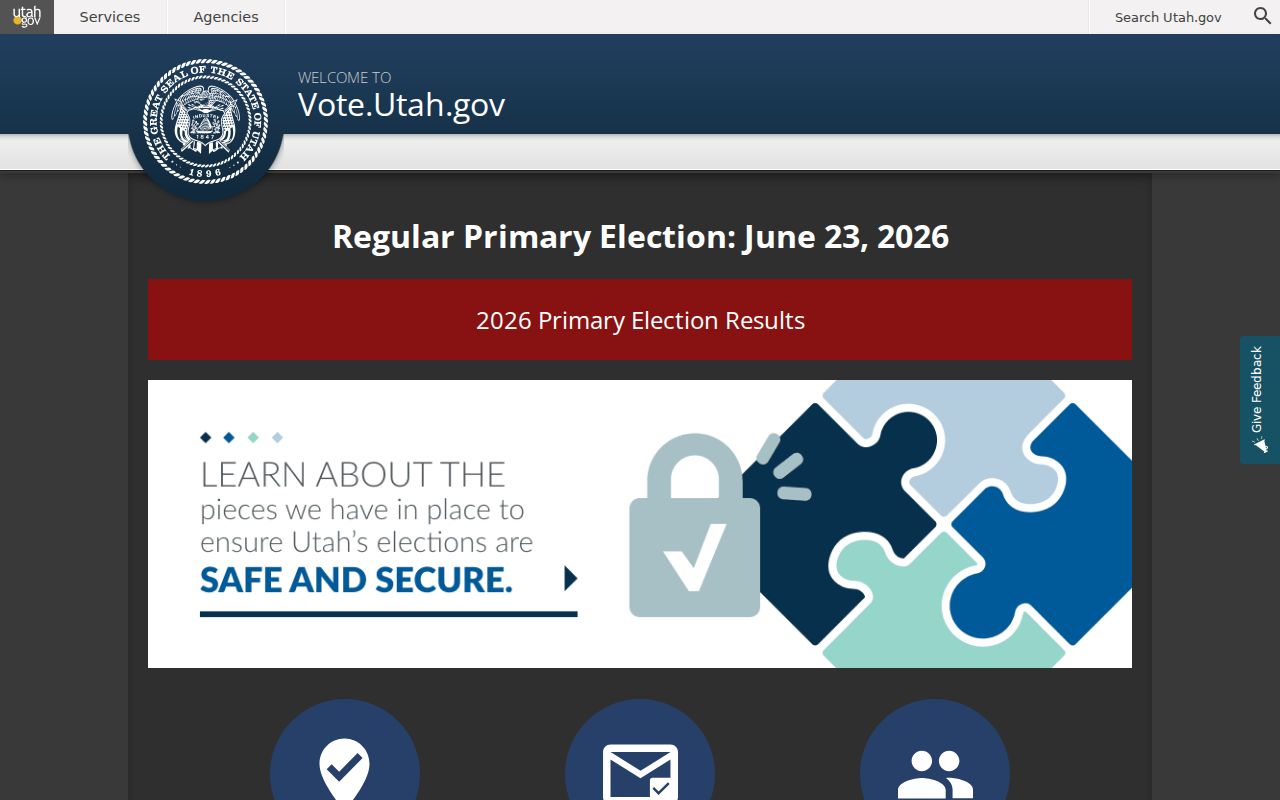
The page routes a Roy voter toward registration status, polling place, districts, ballot details and other personalized election tools rather than exposing a browseable roll.
Fields Returned After a Roy Voter Match
A successful match can join registration facts with election logistics. The application supports physical address and unit, city, state and ZIP, plus a ballot mailing address. It can also show precinct, voter ID, affiliation, status, elected officials, polling and early-vote sites, drop boxes, sample-ballot items and ballot tracking. The fields displayed can change with the election calendar.
| Identity | Full legal name and voter ID |
|---|---|
| Registration | Party or unaffiliated label, active or inactive status, and last update |
| Geography | Precinct and congressional, legislative, school-board, county-council and city-council districts |
| Election activity | Past elections in which the voter participated, never a selected candidate or issue |
| Election services | Polling, early-vote and drop-box information, sample ballot and tracking |
Does participation history reveal a vote? No. A Who Has Voted report records that someone took part in an election. The secret ballot prevents the voter record from identifying any choice.
Note: The research did not submit a real person's details, so it does not establish the portal's exact no-match message.
Roy Voter Records: Public and Private
Utah separates fields that support election administration from credentials that could enable identity abuse. Public file data can include name, voter ID, age range, residence and mailing location, county, precinct, districts, affiliation, status, last update and participation history. The limits arise under Utah's voter record law and the reorganized provisions in Title 20A, Chapter 2.
Confidential voter fields. Full birth date, driver's-license or state-ID number, Social Security number, email, phone and signature are not part of general voter-file release. At-risk identifying information receives added protection.
This distinction matters when reading an official file. An age range is not a full birth date, and an election-participation marker is not a ballot record. A blank protected field should be treated as an access boundary, not as an invitation to reconstruct the data elsewhere.
At-Risk Protection for a Roy Voter Record
Utah can withhold a qualifying voter's identifying information while retaining nonidentifying or aggregate items such as broad geography, age range, affiliation and vote history. Eligible categories documented in the research include a domestic or dating-violence victim or threatened victim, a law-enforcement officer, a person covered by a protective order, an armed-forces member, a public figure, and a co-resident of a qualifying person.
The At-Risk Designation Request Form asks for full name, phone or email, an address or date of birth to find the record, the qualifying basis, an explanation when needed, signature and date. It may go to the Weber County clerk or Lieutenant Governor by mail, email or in person. The designation does not erase the same address from every other government or commercial database.
Qualifying residents may also consult Utah's Address Confidentiality Program about its substitute-address process. Program rules should be followed directly, and no search should try to uncover a protected location.
Weber County Handles Roy Voter List Requests
Roy lies within Weber County, so a county or district list belongs with the Weber County Clerk/Auditor rather than Roy City. The local fallback is the clerk's elections desk in Suite 320 at 2380 Washington Boulevard in Ogden. The published contact details are 801-399-8400, fax 801-399-8300 and rhatch@co.weber.ut.us, with a reported weekday public-counter window of 8:30 a.m. to 4:30 p.m.
The county channel is useful when the self-check cannot answer a list question or when the desired area is smaller than the whole state. Requests may be taken at the counter or through the listed phone, fax and email channels. Statewide data requests use the state order route. General records-law mechanics are treated separately in the Roy public records guide.
Note: Ask the clerk to confirm current counter hours and the available geographic extract before relying on an older schedule.
Order Utah Voter Data for Roy
The Utah voter and election data page distinguishes the complete statewide database from county lists and election reports. A statewide purchase is a tab-delimited database of about 150 MB. It costs $1,050, is sent by email within one business day, and includes no refund, subscription or free updates. Roy entries appear within that state file rather than as a separate city product.
- Choose the state database for statewide data, or contact the Weber clerk for a county or district list.
- Use the official request interface and select the record or election report that matches the planned lawful use.
- Pay the published charge and preserve the delivery date because voter rolls change as registration status is updated.
Who Has Voted and Who Has Been Sent an Absentee Ballot reports cost $35 per election. They cover regular even-year primary and general elections and arrive daily from 21 days before the election through the day before. Precinct-level results requests have no fee, and protected identities are withheld or anonymized.
The official data page also provides the source for the available order routes and formats.
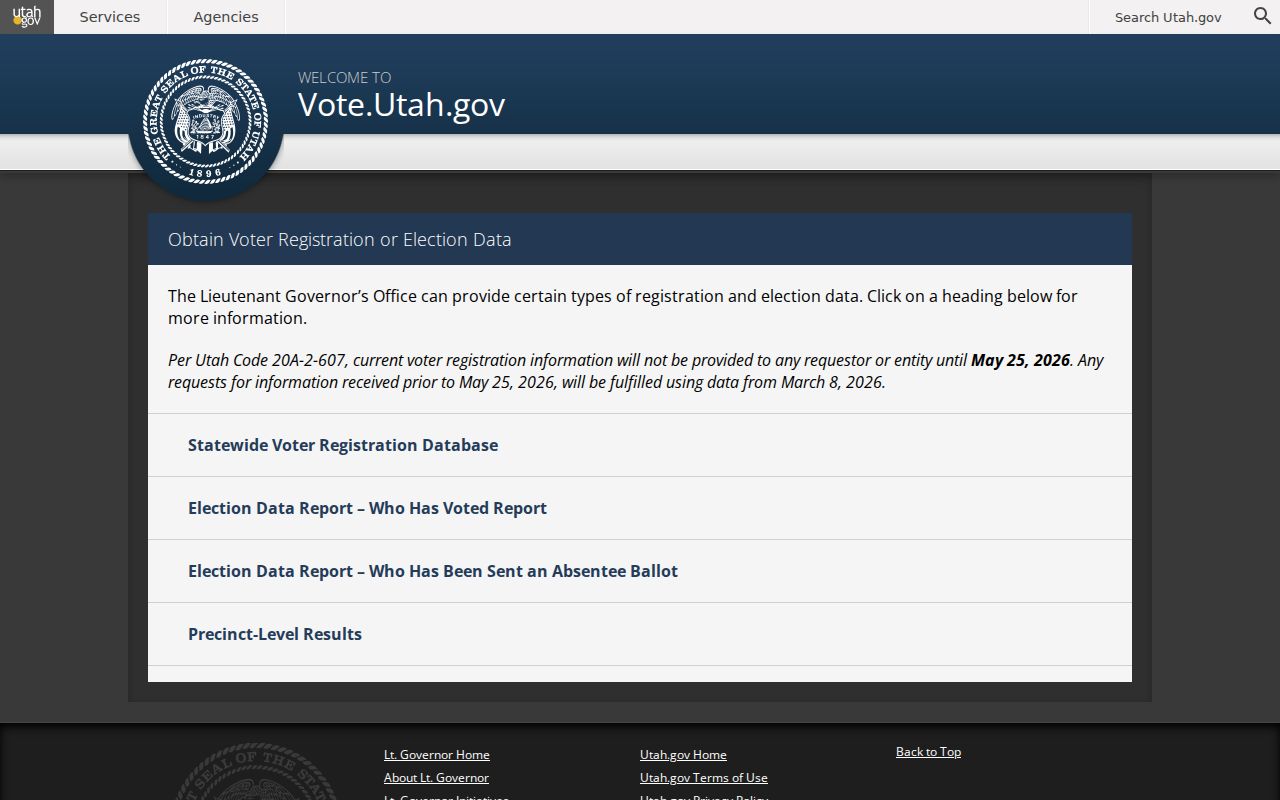
The capture helps distinguish a personal status check from a paid file or election report, each of which answers a different question.
Active and Inactive Roy Voter Roll Status
Registration status is not a permanent label. Utah marks a record inactive after no voting in two regular general elections and no response to the clerk's notice. The National Voter Registration Act data page publishes confirmation-card and removal reports, with reasons that include deceased, inactive and voter request. Removal files begin in November 2025 and have a two-year retention period.
The statewide count published on July 20, 2026 was 2,088,612 voters: 1,778,184 active and 310,424 inactive. Those figures describe Utah, not Roy. No verified city total was found, so it would be wrong to infer a Roy count from the state ratio. A recent clerk response or a dated state file gives stronger evidence than a stale downloaded list.
Check Dates on Roy Voter Data
A voter list needs a source date because release schedules and list maintenance can change what it represents. Utah temporarily withheld the current state file until May 25, 2026 under §20A-2-607. During that pause, earlier requests received a March 8 snapshot. The pause has expired, but a copy made during it should still be described as that snapshot rather than as a live roll.
Utah also planned an Interactive Election Data Hub with county, legislative, local-precinct, age, status, geography and party filters. The research found it marked “Coming Soon” in July 2026, so those filters should not be promised until the tool actually launches. Published National Voter Registration Act files are the more concrete route for studying confirmation and removal activity.
For Roy, record the file name, download or delivery date, geographic scope and whether the source was a self-check, county extract, statewide database or election report. Those details keep two records from different points in the maintenance cycle from being treated as a contradiction.
Historical Roy Voter Registration Sources
Older registration work has a real coverage limit. Utah Archives Series 28818 preserves historical registration material, but the research did not verify a Weber County poll-book or registration-register year span. Search the Archives series description first, then ask staff whether the relevant election year and former precinct survive. Do not promise city-level coverage solely because a present address is in Roy.
Weber County was organized in 1850, its boundaries changed several times, and Roy incorporated in 1937. For an early resident, the record-creation place may therefore be Weber County, an older precinct name, or another jurisdiction rather than modern Roy. That geography makes event year and precinct more useful than today's city label when requesting an old register.
Lawful Limits on Roy Voter Records
Access to voter data never authorizes monitoring, threats or harassment. Utah's stalking law, §76-5-106.5, covers an intentional or knowing course of conduct of two or more acts when the actor knows, or is reckless as to whether, a reasonable person would fear for safety or suffer emotional distress. The listed conduct includes following, surveillance, threats, communications, appearing at a residence and distributing information to a person's associates.
Use the narrowest lawful source. Verify personal election details through the gated lookup, request only the geographic list actually needed, and respect every protected or omitted field.
A first stalking offense is generally a class A misdemeanor, with felony escalators documented in the statute. Immediate danger belongs with 911. A local criminal concern belongs with Roy Police through its official contact. Voter participation also must never be described as proof of how anyone voted.